AEM Cloud Security in 2026: Threat Modeling What Changed vs On-Prem
By Yevhen Kliakhin | Published March 30, 2026
Executive Summary
AEM as a Cloud Service (AEMaaCS) changes the security problem. It removes much of the classic "server hardening" surface, but it elevates governance of the delivery system: identity, pipelines, environment boundaries, edge controls, secrets/configuration, and go-live readiness.
Adobe's platform controls - isolation, managed CDN, rolling updates, and baseline security - reduce certain classes of operational work, while customer misconfiguration becomes a dominant risk driver, especially in Cloud Manager, Admin Console product profiles, Dispatcher/CDN rules, caching headers, and integrations. The right question in 2026 is not "is cloud safer?" but "which attack surfaces changed, disappeared, or moved, and what controls now matter most?"
Introduction
AEM programs in 2026 are modernizing under real pressure: faster release cadence, more external integrations, headless/API expansion, and higher expectations for reliability and incident response. AEMaaCS helps by standardizing delivery through Cloud Manager pipelines, immutable deployment artifacts, and a managed edge, but it also changes where risk concentrates.
The common failure pattern is not a lack of "security tools." It is teams carrying on-prem mental models into AEMaaCS: assuming they can "just log in and fix the server," treating edge rules as a performance concern rather than a security boundary, or seeing Cloud Manager as "DevOps plumbing" instead of part of the attack surface. AEMaaCS is a different operating model: code and configuration are effectively immutable and applied globally via pipelines; updates happen continuously; and delivery policy lives in Git-governed configuration and product-profile permissions.
Core thesis. In AEMaaCS, security posture is less about hardening individual servers and more about governing the delivery system around your application: identities, CI/CD, environment boundaries, secrets/configuration, Dispatcher and CDN behavior, traffic controls, and go-live readiness. The practical question for architects is no longer "is cloud safer?" It is: which attack surfaces changed, disappeared, or moved, and what controls now determine your outcomes?
What Changed from On-Prem to AEMaaCS

AEM 6.5 on-prem security work traditionally centers on infrastructure ownership: OS hardening, patching cadence, local network segmentation, and deep environment access for forensics and emergency fixes. AEM Managed Services reduces some operational load, but still resembles a "managed hosting" model in many organizations' mental map. AEMaaCS is different: Cloud Manager becomes mandatory for deployments, code and config changes are globally applied via pipelines, and the platform is continuously updated.
AEMaaCS is intentionally restrictive in project/runtime behaviors that were common on-prem, including filesystem use, native binaries, and certain Apache directives. These are not just developer constraints. They remove entire classes of drift and ungoverned hot fixes while elevating the importance of controlled configuration as code.
Key takeaway. Classic hardening tasks reduce in importance, while misconfiguration risk in identities, pipelines, edge rules, caching, and integrations becomes central.
Shared Responsibility and Ownership Clarity
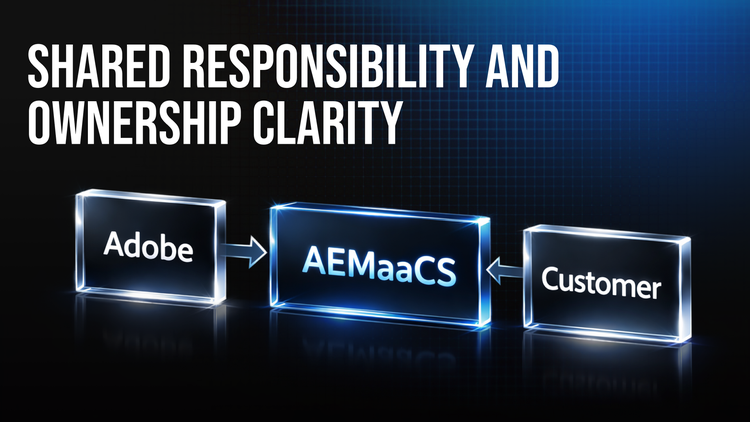
AEMaaCS is not "Adobe handles security." Adobe operates large parts of the platform security model, including tenant isolation, managed CDN capabilities, rolling updates, baseline security controls, and platform monitoring. At the same time, the customer owns what matters most to real incidents: who can deploy, what gets deployed, how traffic is filtered, how caching behaves, what endpoints are exposed, and how data and secrets are handled.
The most useful way to read shared responsibility in AEMaaCS is operationally: Adobe secures and runs the platform baseline, while the customer governs code, identity, deployment workflow, content exposure, integrations, and release discipline.
Threat Model by Layer for AEMaaCS in 2026
This section builds a practical layer-by-layer AEMaaCS threat model and shows how each layer differs from on-prem.
Author Tier
Author is the highest-value target because it is where content, configuration, and often privileged workflows live. Credential compromise through SSO/IdP breach, phishing, or over-privileged accounts remains the dominant risk. AEMaaCS also enforces clustered behavior and rolling updates, which can create operational blind spots if teams expect single-node stability. Treat Admin Console product profiles as a hard boundary, assign the minimum profiles per environment and tier, and implement periodic access reviews and formal offboarding.
Publish and Preview Exposure
Publish and Preview are your public or semi-public attack surfaces: URL probing, bot abuse, API scraping, cache poisoning, and unintended data exposure via endpoints or serialized models. In AEMaaCS, delivery is multi-layer by design: managed CDN plus Dispatcher, and optionally a customer-managed CDN. That means cache behavior and header correctness become security controls, not just performance tuning.
Treat Preview as a controlled exposure surface: segment domains, apply IP allow lists where appropriate, and narrow Dispatcher filters to only the prefixes you need. Headless and GraphQL endpoints should be exposed deliberately rather than through legacy broad allow rules.
Cloud Manager, Git, and CI/CD
In AEMaaCS, the pipeline is the front door to production change. That makes it a high-value target for supply-chain attacks: compromised repo credentials, malicious pull requests, poisoned dependencies, or unauthorized config changes that widen exposure. Cloud Manager is mandatory for build, test, and deploy, and its gates are part of the security model.
Protect main and release branches, require PR reviews and code-owner approvals for security-sensitive paths, and treat Dispatcher/CDN changes as security changes with explicit approval workflows and Dev-to-Stage rehearsal.
Product Profiles, IMS, and Admin Access
Over-privileged identities remain one of the highest-probability cloud failure modes. AEMaaCS formalizes access via IMS and Admin Console product instances and profiles, while Cloud Manager roles are also governed through product profiles. Model least privilege by tier and job function, maintain separate break-glass access with controlled use, and audit access regularly.
Dispatcher Configuration
Dispatcher remains a primary enforcement layer for what reaches Publish and Preview. The most dangerous misconfiguration is also the most basic: if no /filter exists, all requests are accepted. AEMaaCS adds more validation and constraints, but legacy broad rules can still expose admin paths, internal selectors, or unintended GraphQL endpoints.
Start deny-by-default, explicitly allow only required paths, methods, selectors, and suffixes, and validate configuration locally before promotion.
CDN, Traffic Filter Rules, and WAF
In AEMaaCS, Layer 7 protection is intended to happen at the managed CDN layer. Traffic filter rules can restrict access pre-go-live, set rate limits, and block known malicious sources, while WAF rules require the Extended Security license. Use a log-first lifecycle: monitor via CDN logs, deploy in log mode, then enforce blocks as confidence grows. Keep cdn.yaml small and govern it like code.
External Integrations and Advanced Networking
Integrations are often the hidden breach amplifier: leaked API tokens, overly broad OAuth scopes, untracked webhook endpoints, and outbound connections to third-party services that become hard dependencies. Because advanced networking is configured through Cloud Manager, teams need an integration inventory with owner, auth method, secret location, rotation cadence, rate limits, and failure behavior.
Content and Data Leakage
The cloud-specific data leak often happens through configuration: caching headers on sensitive pages, exposed headless content via GraphQL, or overly permissive publish permissions. Multi-layer caching raises the stakes of a single header mistake. Classify content early as public/cacheable versus sensitive/non-cacheable, enforce that with explicit headers and Dispatcher rules, and apply permission constraints to headless content where required.
Secrets and Environment Configuration
Secrets frequently leak through code repositories, build logs, or mis-scoped environment variables. AEMaaCS provides environment variables and secrets in Cloud Manager so sensitive values stay out of version control and can change without redeploying code. Make "no secrets in Git" a hard rule, scope secrets by environment and tier, and rotate them as an operational runbook.
Caching and Response-Header Mistakes
Caching is now a security control because it affects what is stored at the edge and what gets served to users. If headers are misapplied, sensitive content can become cacheable. Perform a header security review as a pre-go-live gate, covering Cache-Control, Surrogate-Control, Set-Cookie, Vary, and Authorization behavior, and validate caching behavior across both CDN and Dispatcher layers.
Operational Security Blueprint
The practical path to strong AEMaaCS security is to treat operational controls as architecture: pipelines, identities, edge policy, and readiness practices.
Pipeline Hardening as a First-Class Security Control
Cloud Manager is mandatory and drives build, test, and deploy. AEMaaCS also uses CI/CD to keep projects current, with Stage acting as an automated quality gate. That makes pipeline quality gates and customer tests relevant to both releases and platform updates.
Use protected branches, required pull request reviews, CODEOWNERS for security-sensitive paths, and explicit sign-off for Dispatcher/CDN changes that widen allowlists, forward sensitive headers, or change caching defaults. Artifact confidence and release governance are security controls, not paperwork.
Environment Access Controls and Identity Design
Least privilege is not optional. AEM access is governed by Admin Console product profiles, and Cloud Manager roles are also managed through Admin Console. Developer Console access can expose environment state snapshots, while Repository Browser is read-only but still aids data discovery if over-granted.
Offboarding must remove access at the product-profile level and review local AEM groups, Cloud Manager roles, and IP allow-list dependencies. Access reviews should be routine rather than triggered only by incidents.
How Dispatcher and Edge Layers Change the Risk Model
AEMaaCS includes an integrated, fully managed CDN. Caching behavior across CDN and Dispatcher defines exposure behavior, and traffic controls plus WAF are part of the go-live surface. Incidents often come from sensitive pages becoming cacheable, broad Dispatcher allow rules, exposed JSON/model endpoints, unblocked admin paths, or header-trust mistakes when a customer CDN sits in front of Adobe's CDN.
Treat edge policy as production security code, not post-launch tuning. Config changes at the edge can create data-exposure incidents just as easily as application code changes can.
Pre-Go-Live Security Blueprint
Adobe's go-live checklist already emphasizes end-to-end pipeline testing, Dispatcher validation, Stage sizing, and traffic-filter rules. The checklist below reframes that guidance as an enterprise security sign-off.
This checklist should be treated as an engineering gate, not a best-effort reminder. It proves that the system is governable before customer traffic arrives.
Common Failure Modes in Real AEMaaCS Programs
These are practical "how programs actually fail" patterns, with cause, damage, and prevention. The common thread is teams optimizing for delivery speed without governing the delivery system.
Carrying over on-prem assumptions. Why it happens: operational muscle memory around SSH fixes, persistent disks, and manual config edits. Damage: drift, broken immutability assumptions, and slow incident response. Prevent it: embrace AEMaaCS constraints and force changes through pipelines and config as code.
Treating Cloud Manager as "just DevOps." Why: platform teams see it as delivery plumbing, not a security boundary. Damage: supply-chain risk, unauthorized deployments, and config changes that widen exposure. Prevent it: harden pipeline governance and enforce branch protections and code-owner reviews.
Over-permissive product profiles. Why: speed pressure during migration or agency onboarding. Damage: privilege escalation and uncontrolled deployments. Prevent it: least privilege by tier, separate Cloud Manager roles, and periodic access reviews.
Weak Dispatcher filters or missing /filter. Why: copied legacy rules and no security review. Damage: unintended endpoint exposure, admin-path probing, and abuse via selectors or suffixes. Prevent it: allowlist first and validate locally.
No traffic filter rules or WAF strategy before launch. Why: teams assume the CDN alone is enough. Damage: bot abuse, volumetric spikes, noisy scanning, and reactive blocking. Prevent it: implement baseline rules early, iterate from log to block, and decide on WAF licensing before launch.
Treating Preview as harmless staging. Why: an outdated internal-network mental model. Damage: content leaks, partner-only content indexing, and expanded attack surface. Prevent it: segment domains, use allow lists and traffic rules, and treat Preview like Publish with controlled access.
Caching misconfiguration causes data exposure. Why: performance tuning happens without security framing. Damage: sensitive pages cached at the edge and leakage via shared caches. Prevent it: review header policy, understand caching eligibility and default TTL behavior, and use fine-grained cache directives.
Unmanaged integrations, secrets sprawl, and missing observability. Why: integrations accumulate over time, nobody owns rotation, and teams watch only AEM application logs. Damage: credential leakage, third-party blast radius, and blind incident response at the CDN/Dispatcher layer. Prevent it: maintain an integration registry, use Cloud Manager secrets, rotate credentials, enable log forwarding, and alert on rule triggers before go-live.
DevHandler Point of View
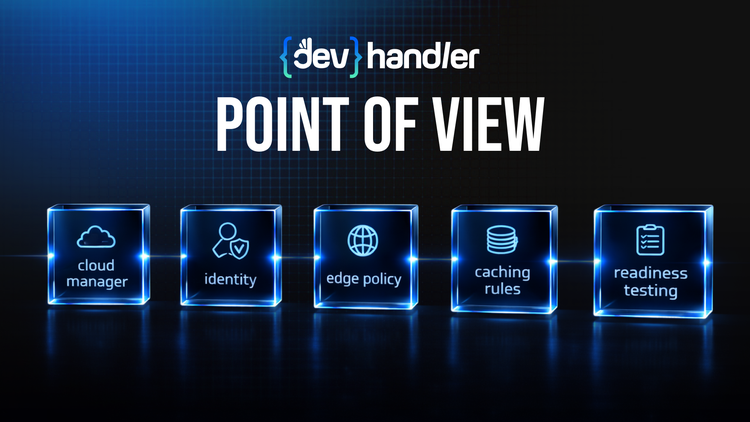
DevHandler's practical stance is that AEMaaCS security succeeds when delivery is treated as one system: security, performance, governance, and release discipline all share the same control points in Cloud Manager, identity, edge policy, caching rules, and readiness testing.
That is why the best security work in cloud programs is often not another appliance. It is tightening the chain: product profiles, protected branches, quality gates, validated Dispatcher/CDN configs, log-first traffic rules, and a real go-live sign-off that proves the system is governable.
Conclusion
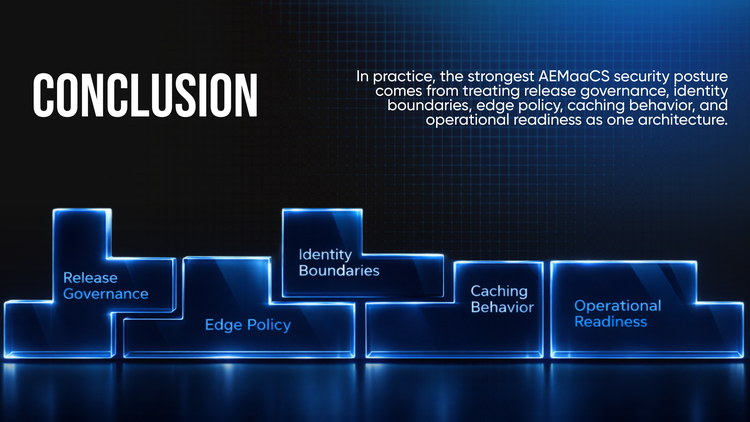
AEMaaCS changes the security conversation because the operating model changed: continuous updates, pipeline-controlled deployments, managed edge, and restricted runtime surfaces. That removes some on-prem hardening work, but it also means failures now cluster around identity governance, pipeline integrity, edge/Dispatcher policy, caching/header correctness, and go-live readiness.
The 2026 win condition is clear: make delivery governable by design, process, and evidence - tests, logs, approvals, and repeatable deployments. When release governance, identity boundaries, edge policy, caching behavior, and operational readiness are designed together and validated before launch, the platform becomes easier to govern, easier to audit, and far less likely to fail in ways that are expensive to unwind.
Read more: