A Year at DevHandler: What We Built, What We Learned, and What’s Next
By Yevhen Kliakhin | Published December 24, 2025
Introduction:
As 2025 comes to a close, we’re reflecting on a year of growth, innovation, and resilience at DevHandler. Over the past 12 months, our team delivered ambitious projects for clients, embraced new tools and workflows internally, and charted a clear course for the future. In this year-end review, we share what we built (and the impact it had), what we learned (and improved within our team), and what’s next for both our clients and DevHandler in 2026. Throughout, our focus remains on clear value: faster content, smarter personalization, and a resilient delivery culture that turns challenges into opportunities.
What We Delivered in 2025 – And Its Impact on Clients
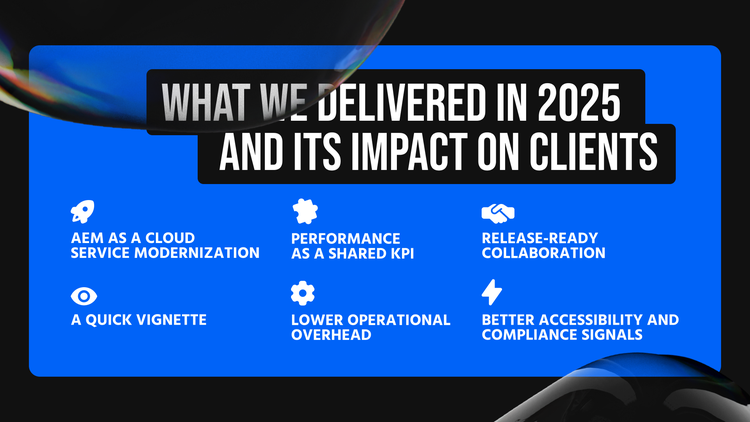
This year, DevHandler doubled down on delivering faster, smarter digital content solutions for our clients. We leveraged our deep Adobe expertise and Eastern European tech talent to accelerate projects without sacrificing quality. In practice, that meant embracing cutting-edge Adobe tools and approaches to solve our clients’ content and experience challenges:
1. AEM as a Cloud Service modernization: Alongside new builds, we supported enterprise teams moving toward a cloud-native AEM foundation. For clients, “cloud- native” is less about buzzwords and more about day-to-day reliability: predictable environments, fewer manual deployments, and modern CI/CD gates that reduce release risk. We approached modernization in phases — stabilize first, then simplify, then optimize — so teams could keep shipping while we improved the underlying platform. That sequencing helped stakeholders see progress early, without waiting for a single “big bang” launch.
2. Performance as a shared KPI: In 2025, performance stopped being a “front-end task” and became a cross-functional responsibility. We worked with enterprise teams to define performance budgets, align on what “fast enough” means for users, and build a repeatable playbook: optimize images and fonts, reduce blocking scripts, and validate changes with automated checks. This is one reason our own site can consistently achieve a Lighthouse Performance score of 99 and perfect scores for Accessibility, Best Practices, and SEO — we treat quality signals as part of delivery, not a cleanup step at the end.
3. Release-ready collaboration: We also leaned into a simple idea: the best delivery speed comes from reducing friction between teams. When content authors can update content independently, developers can focus on higher-value work. When engineers have clear requirements and fast feedback, marketing teams see fewer surprises. Across projects, we used short demo loops, shared checklists, and transparent progress tracking to keep alignment tight — especially when requirements shifted mid-sprint.
- AI-Native Content Workflows: We began integrating Adobe’s new AI- powered Content Assistants (“agentic” AI helpers) directly into content production. Instead of treating AI as a gimmick, we made it a co-pilot in our workflows – aiding with draft creation, SEO suggestions, and even generating A/B test ideas. The result? Content cycles sped up noticeably. Early pilots showed that tasks like drafting page copy or creating image variants could be completed in seconds with AI assistance, versus days manually. This AI-native approach boosted our capacity to iterate and experiment for clients. Our marketers and authors could test multiple content variations quickly, learning what works best without lengthy delays. In short, AI helped us deliver more content, more consistently – a key advantage when enterprises must produce more personalized content than ever in tight timeframes.
- Edge Delivery Services (EDS) for Performance: We were an early adopter of Adobe’s Edge Delivery Services, and 2025 proved why this bet was worthwhile. Across pilots and client engagements, EDS helped us deliver content from the edge of the network — meaning pages are globally cached and consistently fast for users everywhere. The result was a noticeable improvement in perceived speed, Core Web Vitals stability, and day-to-day publishing agility. Instead of waiting on deployment windows, approved updates could go live quickly, with changes authored in documents and promoted through clear review steps. This made it easier for enterprise teams to keep campaigns current while preserving governance and release confidence.
4. A quick vignette: Mid-year, one team faced a common enterprise reality: a campaign deadline moved up, and the scope changed after legal review. Instead of rushing risky changes into a monolithic release, we split the work: content updates shipped through a controlled document-based workflow, while deeper template changes went through our usual review and automated checks. The launch still happened on time — and the team kept quality steady, because the process made it clear what could move fast and what needed guardrails. After that, the client adopted the same approach for future campaigns, turning a one-off scramble into a repeatable operating model.
- Hybrid Authoring (Docs + Visual Editor): Another highlight was helping clients adopt AEM’s new Universal Editor and document-based authoring in tandem. Traditionally, enterprise content was either created by developers in a CMS or by business users in documents, but not both. In 2025 we proved you can have the best of both worlds. For example, we guided an enterprise team in rolling out a dual-authoring model: core pages remained managed in AEM’s visual editor (to keep design consistency), while regional teams used document-based authoring via EDS to spin up campaign pages quickly. Both methods pulled from the same design system, so a content block in a Google Doc published with the same quality and styling as a component-driven page. The payoff was speed and autonomy — teams could ship updates the same day rather than waiting through long queues — while still keeping brand and review guardrails intact.
Each of these advancements contributed to real, tangible outcomes for our clients. We weren’t interested in new tech for its own sake; we wanted results that business stakeholders care about – better user engagement, higher conversion rates, and faster time-to-market. Below is a quick summary of what our 2025 deliveries meant in practice for the organizations we serve:
- Faster time-to-market: Content updates and campaign launches that used to take weeks now go live in days or hours, thanks to AI-assisted writing and document-based publishing. For example, marketing teams can publish approved content same-day rather than waiting on release cycles. This responsiveness helps our clients capitalize on market opportunities in real time.
- Improved site performance (SEO and UX): By leveraging edge delivery and performance tuning, we slashed load times significantly. Many pages now consistently hit Core Web Vitals benchmarks – yielding better SEO (higher search rankings) and lower bounce rates as users don’t abandon slow pages. Faster, smoother sites not only please users but also drive up conversion metrics.
- Empowered content teams: Business users and content authors gained new independence through hybrid authoring tools. Non-technical team members can create or edit web pages via intuitive interfaces (like the Universal Editor’s in-context editing or simply writing in Docs) and see their changes live quickly. This means less bottlenecking on IT and more content output overall. One client’s content team, for instance, published 50+ pages this year without a single Jira ticket for a developer – a big confidence boost for them and a capacity boost for the organization.
- More experimentation & personalization: With AI generating variant content and seamless A/B testing in place, our clients are testing ideas more frequently and learning what works faster. That automotive brand’s 8% lift in leads from a homepage experiment is one example. Across projects, we’ve seen that a culture of experimentation (backed by tools that make it easy) leads to continuous improvement in engagement and sales.
- High reliability and support: Despite moving fast, we maintained a high bar for quality and reliability. Our distributed delivery model ensured coverage across time zones, and our deep Adobe specialization meant issues got resolved quickly. Notably, several clients noted this year that they had zero major incidents during big campaign launches – a result of diligent testing, monitoring, and the rock-solid stability of AEM Cloud and EDS when configured well. Peace of mind is an impact, too, and we’re proud that our work provided it.
Lower operational overhead: Modern delivery is also about maintenance. By standardizing patterns, reducing custom complexity, and leaning on cloud-native capabilities, we helped teams spend less time on “keeping the lights on” and more time on improvements that users actually feel. For stakeholders, that often shows up as fewer release escalations, simpler governance, and clearer ownership across teams.
Better accessibility and compliance signals: Enterprises can’t treat accessibility as optional — it’s part of brand trust and often a legal requirement. In 2025, we brought accessibility checks earlier into delivery, so teams could catch issues before they compound. When combined with performance and SEO discipline, this creates a stronger baseline for every new page and feature.
How We Worked – and What We Improved Internally
Behind the scenes, 2025 was a year of refining how we work at DevHandler. Great outcomes for clients are only possible if we continuously improve our own processes and skills. This year, our team embraced new practices and strengthened our culture in several important ways:
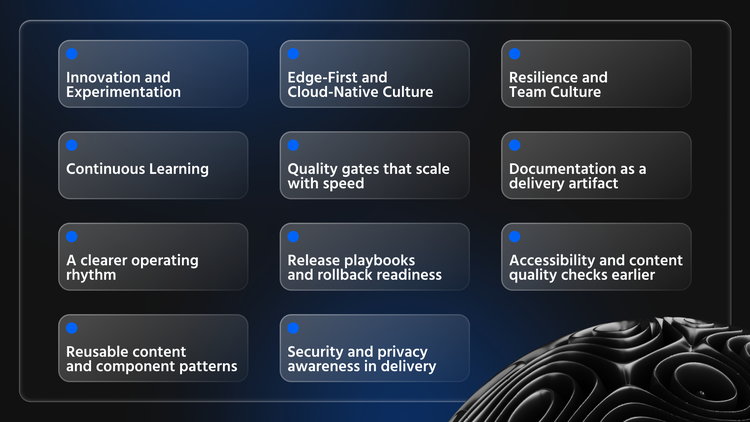
1. Innovation and Experimentation: We fostered a mindset that experimentation isn’t just for our clients’ marketing teams – it’s for us too. Internally, we gave ourselves room to pilot the same cutting-edge tools we recommend. For instance, our developers and content strategists experimented with AI content assistants to speed up internal tasks like drafting knowledge base articles and code documentation. We also ran performance drills on our projects, treating each engagement as a chance to fine-tune our automation and CI/CD pipelines. The learnings from these experiments fed back into client work, creating a virtuous cycle of improvement.
2. Edge-First and Cloud-Native Culture: Adopting Adobe’s Cloud Service and edge tools changed not just our tech stack but our mindset. This year we fully embraced an “edge-first” approach – assuming content should be as close to the user as possible and every millisecond matters. We baked performance optimization into every step (from design to deployment), automating Lighthouse testing and Core Web Vitals monitoring in our pipelines. If any build caused a performance regression, our team caught it before it reached production. This discipline paid off: our own website consistently scores ~99 in performance and a perfect 100 in SEO on Lighthouse audits. That obsession with speed and quality seeped into all our projects. Internally, we also made document-based publishing a norm for certain content, even for our blog posts – if writing in Google Docs and pushing to the site is faster and easier forthe team, we’ll do it. By adopting the tools we deploy for clients, we became our own case study and gained first-hand empathy for authors using them.
3. Resilience and Team Culture: As a distributed team rooted in Ukraine, 2025 tested and proved our resilience. Our entire company has been remote-friendly and distributed from the start, but this year we leaned on that strength more than ever. Even amid external challenges (from infrastructure outages to broader uncertainties), our team’s commitment never wavered. We supported each other across multiple cities and time zones, ensuring coverage and backup for every project. Daily stand- ups, clear RACI roles, and a culture of transparent communication meant that no matter the situation, work moved forward smoothly. In fact, we often turned what could be disadvantages into advantages – for example, having team members in different time zones allowed us to hand off work and provide almost 24-hour development coverage when needed. This “do whatever it takes” mindset is something we take pride in, and it reflects what we call Ukrainian tech excellence. It’s about professionalism, pragmatic problem-solving, and reliability even under pressure. By continually investing in our people’s well-being and growth, we created an environment where challenges are met with a can-do attitude rather than excuses.
4. Continuous Learning: Finally, we made it a point to keep learning. Adobe’s platform evolves quickly (this year alone saw new features like the Universal Editor, AEM Sites Optimizer, and more). Our team completed additional Adobe certifications, held knowledge-sharing sessions, and even mentored junior colleagues through real client work. One thing we improved was cross-functional understanding – developers learned more about marketing concerns, and analysts learned more about code – so we can collaborate without silos. The result is a team that’s more well-rounded and ready to tackle problems holistically, not just within narrow lanes.
5. Quality gates that scale with speed: Tighter timelines and shifting requirements were a constant theme this year. To keep quality high at scale, we strengthened our definition of “done.” That meant more consistent peer reviews, clearer acceptance criteria, and automated checks that run the same way every time. We focused on practical coverage: unit tests where logic matters, integration checks where systems touch, and lightweight smoke tests for critical user journeys. The goal wasn’t to slow teams down — it was to make fast delivery safer.
6. Documentation as a delivery artifact: We also treated documentation as part of the product. For enterprise stakeholders, “handover” often fails when the implementation is solid but the knowledge stays in people’s heads. So we standardized short, usable docs: how to publish safely, how to request changes, how releases are validated, and what to do when something looks off. This made onboarding smoother for client teams and reduced dependency on any single person on either side.
7, A clearer operating rhythm: As the team grew, we made our collaboration patterns more explicit. We refined how we run discovery, how we translate goals into backlog items, and how we communicate trade-offs when scope shifts. For clients, that clarity reduces surprises. Internally, it keeps work focused on outcomes rather than activity.
All these internal efforts sharpened our delivery. Here’s a brief rundown of what we improved this year inside DevHandler:
- Integrated AI into our workflow: We started using AI co-pilots for content and code to eliminate grunt work and accelerate creative tasks (e.g. using Adobe’s Content AI to draft copies and suggest optimizations). This saved time and made our output more varied and innovative.
- Edge delivery & automation by default: Every project now follows an edge- first philosophy. We built expertise in Adobe EDS to deploy content globally for speed, and we automated performance checks in CI/CD. No more “afterthought” performance tuning – it’s continuous. (Our own site’s near- perfect Lighthouse scores show the impact.)
- Dual authoring enablement: Internally and for clients, we embraced the dual model of document-based authoring and visual CMS editing. We refined processes to safely mix the two – ensuring that whether a page comes from a Google Doc or the AEM editor, it meets the same quality standards and review workflows. This flexibility empowered our non-developer teammates to contribute more and faster.
- Stronger remote collaboration: We honed our distributed teamwork playbook – including redundant communication channels, more frequent check-ins during critical project phases, and explicit contingency planning. These improvements meant that even in uncertain times (like local power outages or internet issues), we never missed a delivery commitment. Our clients experienced seamless service, which is a credit to our team’s preparedness and dedication.
- Team development and training: We invested in growing our people. Seasoned DevHandlers mentored newer members, especially in specialized Adobe skills, ensuring knowledge transfer. We also encouraged every team member to spend a portion of time on R&D – tinkering with new Adobe features or adjacent technologies (like headless front-end frameworks). This year, one of our engineers became an Adobe Certified Expert in AEM Cloud Service, and another pioneered the use of AEM Headless with a React front-end in a sandbox. Small wins like these keep our skills sharp and our services relevant.
Release playbooks and rollback readiness: We standardized lightweight release playbooks: what to verify before a deploy, how to monitor right after, and how to roll back safely if needed. That discipline matters most when the pressure is high — and it helps teams keep confidence when releasing frequently.
Accessibility and content quality checks earlier: We moved accessibility review and content quality checks earlier in the cycle, not as a last-minute checklist. Catching issues early reduces rework and helps teams build consistent habits that stick across projects.
Reusable content and component patterns: We invested in repeatable building blocks — content models, component patterns, and design-system-aligned templates. This reduces implementation effort on new pages and keeps experiences consistent across channels and teams.
Security and privacy awareness in delivery: Even when the project isn’t “security- focused,” enterprise delivery has to be privacy-conscious. We tightened how we review third-party scripts, how we manage environment secrets, and how we think about consent and tracking from the start — so privacy and compliance don’t become last-minute surprises.
What’s Next for Clients and DevHandler in 2026
Looking ahead to 2026, we’re excited and prepared for the next wave of digital experience trends. The industry is moving fast, but we see that as an opportunity. Our vision for the coming year is to help our clients stay ahead of the curve by focusing on a few key areas that will define success in 2026. Here’s what’s next on our roadmap (and what it means for our clients):
- AI as a Co-Creator (Not Just a Buzzword): We plan to deeply integrate AI- native operations into content and development workflows. In practical terms, this means more AI-assisted content generation, automated insights, and “agentic” assistants working alongside our team to triple-check quality or run experiments. The goal is to double content velocity again without doubling effort – AI will help generate first drafts, propose variations, and even personalize content for audience segments. For clients, this translates to even faster campaign turnarounds and the ability to target micro-segments with tailored content. We’ll ensure the human touch and brand voice remain, but routine tasks will be sped up by AI (in line with Adobe’s latest capabilities). In a competitive environment where marketers need to do more with less, this is a game-changer. Expect more content, more testing, and more data-driven refinement at breakneck speed, powered by an AI+human partnership.
How we’ll approach this with clients is practical and staged. We’ll start with low-risk surfaces — metadata, internal drafts, and variant generation — then expand toward production content where the workflow and governance are proven. The key is keeping humans in the loop: AI can accelerate creation and analysis, but brand voice, factual accuracy, and compliance still need clear review steps. Our goal is AI-enabled speed that feels controlled, not chaotic.
- Privacy-First Personalization: With regulators and browsers continuing to clamp down on old tracking methods, 2026 will be the year of first-party data and privacy-centric personalization. We’re gearing up to help clients build personalization that earns user trust. This means implementing robust consent management, server-side data collection, and using Adobe Experience Platform (AEP) to harness rich first-party customer profiles – all with clear consent and value exchange. Customers today demand transparency, and brands that honor privacy will stand out. We’ll guide clients in shifting from third-party data crutches to strategies where they capitalize on the data their users want to share. The result will be personalization that feels helpful, not creepy, and compliance baked in by design. In short, privacy-first is becoming the only sustainable path to personalization, and we’ll make sure our clients are ahead of that curve, not scrambling behind it.
In 2026, many organizations will also need to rethink measurement. As tracking becomes more restricted, teams have to rely more on first-party signals, server-side collection, and consent-aware analytics. We plan to help clients map data flows end- to-end — from user consent to activation — so personalization stays both effective and respectful. That’s how you build long-term trust while still learning what content and experiences work.
- Edge Everywhere – Lightning-Fast Experiences: In 2026, users will expect every digital experience to be virtually instant. Our roadmap therefore doubles down on edge delivery and performance optimization for everything we build. We envision a world where a vast majority of our clients’ content (marketing pages, product catalogs, blogs, you name it) is delivered from the edge, with sub-second load times as the norm. We’ll continue to refine our use of Adobe EDS and Content Delivery Networks, and explore new edge compute options to move logic closer to users. For clients, this commitment means better SEO (Google loves fast sites), higher mobile conversion rates, and peace of mind during traffic spikes – because edge architectures scale effortlessly. We’ll also keep raising the bar on performance monitoring and tuning, so that “90+ Lighthouse score” and green Core Web Vitals are standard deliverables for every project. Speed isn’t just a feature; it’s the foundation of great UX, and we’re treating it as such.
We’ll continue to pair edge delivery with a performance operating model: real-user monitoring (not just lab scores), performance budgets, and clear accountability. The result is fewer surprises: you can ship faster because you can see regressions early and correct them before they impact users.
- Dual Authoring as the New Normal: The success we’ve seen with hybrid authoring will become a blueprint for more organizations. In 2026, we anticipate dual authoring models (where content creators can choose the best tool for the job – be it a doc or a traditional CMS interface) to gain wider adoption. DevHandler will expand our enablement here: more training for client teams on using the Universal Editor for in-context edits, more playbooks for safe Google Docs-to-web workflows, and enhancements to governance so that flexibility doesn’t mean losing control. Our vision is that marketing and content teams should be able to publish straightforward content on their own (with proper approvals) while developers focus on complex features – all within a unified platform. We’ll help clients achieve this by extending the rollouts of Universal Editor and document-based authoring we started this year, turning early pilots into organization-wide capabilities. The benefit will be huge: a leap in content volume and freshness, without a leap in headcount. One global client’s success with this approach (50+ pages published by non-devs in a few months) is evidence that dual authoring can unlock productivity while maintaining brand consistency. We’re excited to make this a standard option in every AEM implementation we touch.
A big part of making dual authoring work is enablement. We’ll provide playbooks and short training sessions that show authors how to publish safely, how to use templates, and how to run small experiments without breaking consistency. When teams understand the guardrails, they can move fast without fear.
- Composable & Hybrid Architectures: Flexibility in architecture is becoming paramount. We’ve watched monolithic digital experience platforms give way to more composable, headless, and hybrid architectures, and we expect this trend to accelerate in 2026. DevHandler’s strategy is to help clients modernize pragmatically: we won’t rip and replace what works, but we will integrate modular services where they add value. Concretely, this means leveraging AEM’s headless capabilities (like Content Fragment APIs and GraphQL) to feed content to apps and emerging channels, plugging in best-of-breed microservices (for search, e-commerce, and personalization) alongside AEM, and ensuring all these pieces work in harmony. Hybrid is not a compromise in our view; it’s the reality for large enterprises, and we aim to be the experts in making hybrid setups sing.
Composable doesn’t have to mean complex. We’ll help clients define which systems own which responsibilities, standardize APIs and content models, and reuse components across teams. That governance is what keeps a hybrid stack from turning into a patchwork over time.
AI search readiness and citable content: Search behavior is changing: people increasingly discover answers through AI assistants and AI-powered search experiences. In 2026, we’ll help enterprise teams make their content easier for both humans and machines to understand — using clear information architecture, well- structured pages, consistent headings, and schema where appropriate. The goal is simple: when customers ask AI a question in your domain, your site should be a trustworthy source that can be cited confidently.
- Continuous Delivery, Continuous Improvement: Lastly, an overarching theme for us is to keep improving how we deliver. 2026 will see us refining our agile processes even further – think shorter feedback loops, more automation in testing and deployment, and even closer collaboration with client teams. We believe the organizations that thrive will be those who can execute quickly and adapt. So, we’re committed to practicing what we preach: using data and feedback to incrementally get better every sprint. Whether it’s incorporating Adobe’s latest DevOps tools or expanding our 24/7 support capabilities, we’ll do whatever it takes to ensure our clients can move fast with confidence. And as a company proud of its boutique, distributed roots, we’ll continue to leverage our global talent and resilient culture to give clients the best of both worlds – the personal, agile touch of a small team with the expertise and reliability of a big firm. In the year ahead, expect us to remain laser-focused on marrying innovation with pragmatism, just as we always have.
For many enterprise teams, “delivery” is only part of the challenge — sustaining and evolving the platform is the real work. We’re building support and enablement options that keep momentum after launch: regular health checks, performance reviews, content ops coaching, and roadmap planning. It’s a partnership model designed for steady improvement, not one-off wins.
Closing Thoughts: If 2025 taught us anything, it’s that embracing change early and thoughtfully yields tremendous benefits. We enter 2026 with confidence that the trends above – AI in content ops, privacy-first design, edge-first performance, and flexible architectures – will define the next generation of digital experiences. Our promise to clients and partners is to continue learning, adapting, and leading in these areas so you don’t have to play catch-up.
As always, we measure our success by your success. We’re incredibly grateful to our clients who trusted us this year, and proud of our team (spread across Ukraine and beyond) for delivering excellence every day. Here’s to another year of innovation and partnership!
What’s next roadmap
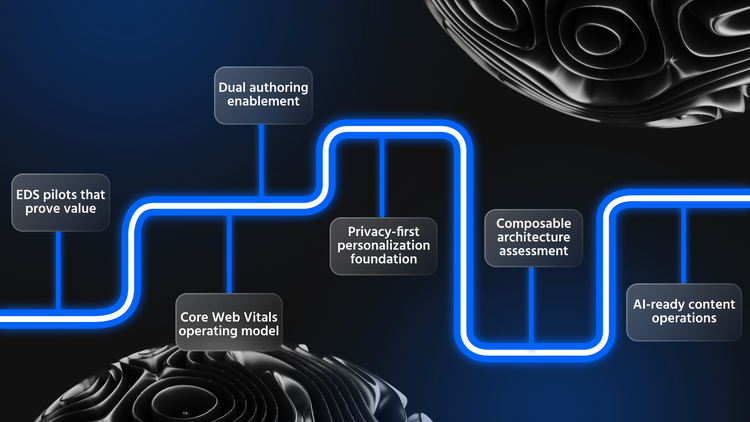
1) EDS pilots that prove value: Identify one high-impact area (campaign hub, blog, or landing pages) and ship it on EDS with document-based authoring, so teams can feel the speed and publishing autonomy quickly.
2) Core Web Vitals operating model: Move from one-time optimization to continuous performance: budgets, monitoring, and automated checks tied to releases.
3) Dual authoring enablement: Roll out Universal Editor and Docs workflows with clear roles, templates, and review steps — empowering authors without losing governance.
4) Privacy-first personalization foundation: Align consent, first-party data, and activation flows so personalization remains effective in a privacy-restricted world.
5) Composable architecture assessment: Map your current stack, identify integration pain points, and plan a pragmatic hybrid path that reduces risk and increases flexibility.
6) AI-ready content operations: Introduce AI co-pilots where they reduce effort immediately — drafts, variants, analysis — while setting strong quality and brand guardrails.
Let’s Shape 2026 Together. If any of the ideas in this reflection sparked interest or questions for your organization, we’d love to chat. Whether you’re aiming to speed up your content pipeline, considering a move to AEM’s edge architecture, or just want to compare notes on digital strategy, feel free to reach out. At DevHandler, we thrive on these conversations – and we’re always ready to help turn ambitious plans into tangible results. Thanks for reading, and here’s to building an even better digital future, together.
Read more: